Rather than a lesson plan on how to learn Akkadian, this is meant as a journal to both document my journey into the world of ancient languages, beginning with Akkadian and cuneiform, and to reach out to the community of people that I know must exist who are also interested. Some trying to track down sources, like me, and others who already know quite a bit more.
I could scribble away in the darkness and privacy of my room learning by trial and error, my mistakes never seeing the light of day. But I decided that I didn’t mind my blunders and round about way of learning being published for the scrutiny of strangers and spambots alike, if, in exchange, I might receive some sense of accountability to keep me going and maybe even a helpful hint or two from a kind stranger.
This is also going to be a publicly documented learning curve on the ways of blogging and website building. So you have been warned 🙂
The Akkadian Language
My interest in Akkadian stems from a love for the Old Testament and ancient Mesopotamia. The Akkadian Empire was centered on the city of Akkad, one of the cities mentioned in Genesis as having been founded by Nimrod after the flood. And it expanded to include Ur, where Abraham came from, as well as several other cities of historical and Biblical interest.
Akkadian was contemporary with other ancient Semitic languages such as Sumerian, Classical Hebrew, and Aramaic. The language diverges into Assyrian in the north, and Babylonian in the south.
Having been written in cuneiform on clay tablets, which unlike papyrus, have remained relatively well preserved up to this day, we have a huge written corpus for this language, and I’ve heard (and if I can find sources discussing this later on I will point them out) that there are hundreds of tablet fragments stored in various museums and the like which haven’t even been translated yet. Not to mention the hundreds no doubt left to find and excavate. This is a fascinating concept to anyone interested in history — all the things yet to be learned.
Most famously, Hammurabi’s Code was written in Akkadian, as well as one of the longer versions of Gilgamesh we have extant. There are also many myths and heroes in Akkadian literature, unfamiliar to most of us, that I have been discovering and developing a love for this past year.
Initial Sources
My initial research into learning Akkadian led me to Huehnergard’s A Grammar of Akkadian which is available online for free, and during this first week I read through the Introduction and printed out Lesson One.
I also wanted to get into cuneiform right away, although Huehnergard mentions introducing the cuneiform in this course a little bit later, I figured it wouldn’t hurt to get my feet wet right off the bat. The first thing I found was the British Museum’s page on learning cuneiform https://www.britishmuseum.org/blog/how-write-cuneiform and watched the video at the bottom, but honestly I didn’t find it very satisfying. I felt like it was catered more towards mildly interested passerbys than prospective students, and in hindsight I think that was probably its purpose.
I did spend a few days trying to practice the cuneiform symbols listed on the chart, but I would like more of a walkthrough on how to write the symbols, if such a thing exists. My attempt to copy the chart was more frustrating than engaging. Subsequent research only pulled up the fact that cuneiform was pressed into damp clay with cut reed tips, and I already knew that much. I haven’t located a straight-up guide on how to write the symbols yet, it’s possible Huehnergard will go into that and I’m wasting my time, but the internet has so far disappointed me.
Besides writing the symbols with the easily-available pen and paper, there is also the option of clay and stylus. At first, I had dismissed the idea — it’s going to be a hassle enough learning a new writing system, much less learning it via an entirely foreign medium, I thought. But while I was struggling to copy the cuneiform chart on the British Museum’s webpage, I started thinking that clay might actually be the better way than paper as the symbols exist to be written into clay, and (who knows?) maybe messing around with clay and reed tips might just be half the fun of learning cuneiform in the first place.
So I did some poking around of what that would involve, what kind of clay, etc. and I found an adorable little blog simply called “Writing Cuneiform” at https://writingcuneiform.blogspot.com/ and I’m so down. He has a step-by-step guide which I intend to try in the coming weeks, and mentions a Introduction to Ugaritic also by Huehnergard that apparently has diagrams of the order the strokes were written in antiquity, which is exactly what I was looking for. I haven’t actually checked it out yet, and like I said, the same thing might already be a part of A Grammar of Akkadian as I haven’t gotten around to scrolling through that too much, but regardless of how I come by it, having a basket of my very own cuneiform tablets is a newly-discovered dream.
Huehnergard, A Grammar of Akkadian: Lesson One
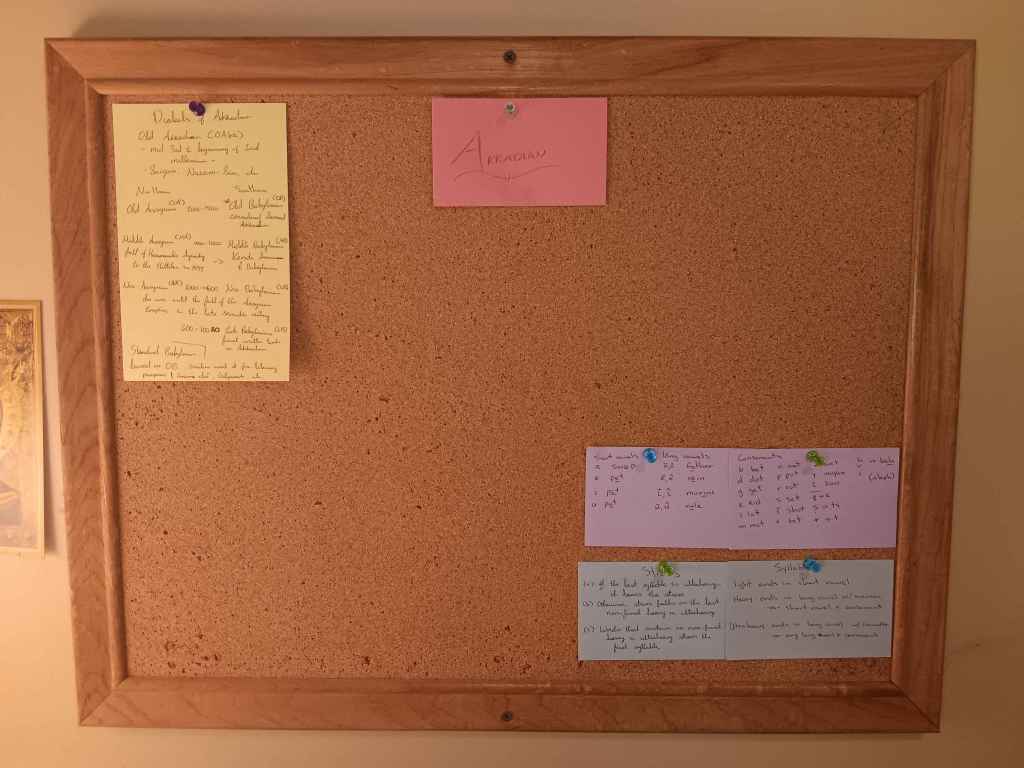
I cleared my corkboard by my desk and copied down the dialects of Akkadian (upper left) mentioned in the introduction, as well as the pronunciation guide and syllable stress rules (lower right) mentioned in lesson one. Then I went through the vocabulary words for this week and divided them into syllables, determined the stress, and practiced saying them out loud.
My only question on this part is: are the r’s rolled? The text doesn’t say they are, but it feels so right to roll them.
Honestly, I skimmed through exercises B and C as I felt like copying the pronunciation guide onto notecards and pinning it up was sufficient. But I did do Exercise E for additional practice.
I feel like I’ve a pretty good grasp on the vocabulary for the week thanks to some old-fashioned flashcards. I found some less than old-fashioned flash cards on Quizlet for Huehnergard’s Grammar already premade, but I get sick of looking at screens all the time, so I haven’t flipped through them yet.
My Latin professor always emphasized “spending time with the language” by writing things out as much as possible, so I also wrote this week’s vocabulary out a couple of times and practiced dividing them into syllables and determining type of syllable and stress.
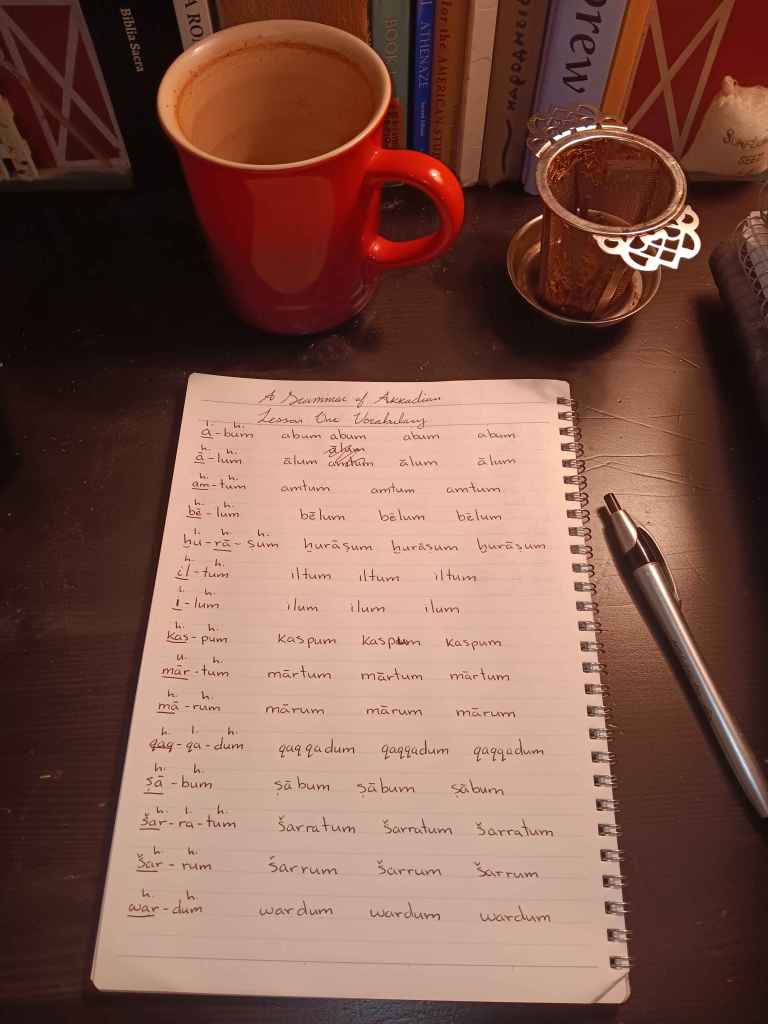
As a Week-in-Review, all I’ll say this far into it is (I absolutely love this language for no particular reason and) hopefully as my knowledge of Akkadian grows, so will the professionalism of my photography. 🙂
 Ment of Wonder
Leave a comment