Unfortunately, this week I was fussing about the technical aspects of blogging and getting my domain set up more than I was working on my Akkadian. I’m going to be taking a second week to work on Lesson Two, but in the meantime I figured I’d discuss what progress I did make.
Huehnergard’s Lesson Two
I’ve never learned a language straight from a textbook like this before, and I’m trying to be extremely careful about my pronunciation of each word, since I have no one else to go off of, and I’m trying to actually absorb what I’m reading when I read through the grammatical explanations.
Two things I was struggling with this week were the prepositions and the grammatical genders.
Prepositions have always been something I’ve struggled with learning because they are rarely one-to-one translations. So instead of writing “iltum” on one side and “goddess” on the other for flashcard memorization, or writing “mutum” repeatedly while thinking “husband,man” doesn’t work as well when it’s “ina” on one hand and “in, into, at, among; with (things), by means of, by; from, from within…” and so forth on the other hand.
I finally came up with the idea of pinning a preposition cheat sheet on my corkboard and excluding the prepositions from my flashcard set. This way I can easily reference them for the translation exercises and not have to deal with any cumbersome flashcards.
As for the grammatical genders, that’s probably just something I need to spend more time with, and I really didn’t dedicate enough time to Akkadian this week. What’s throwing me off at this point is if bītum and liptum are masculine, because the t is a part of the base rather than the case ending, as the lesson mentions, then why is the plural bītātum and not bītū? Is it the same for liptum? And if they decline like a fem. noun anyhow, then why even bother making them masculine?
I have zero doubt that it is just one of those linguistic “it is what it is” things. We could go on and on about English’s discrepancies in the same way. But it is also contributing to my feeling that I need to spend more time on this lesson in case I’m missing something.
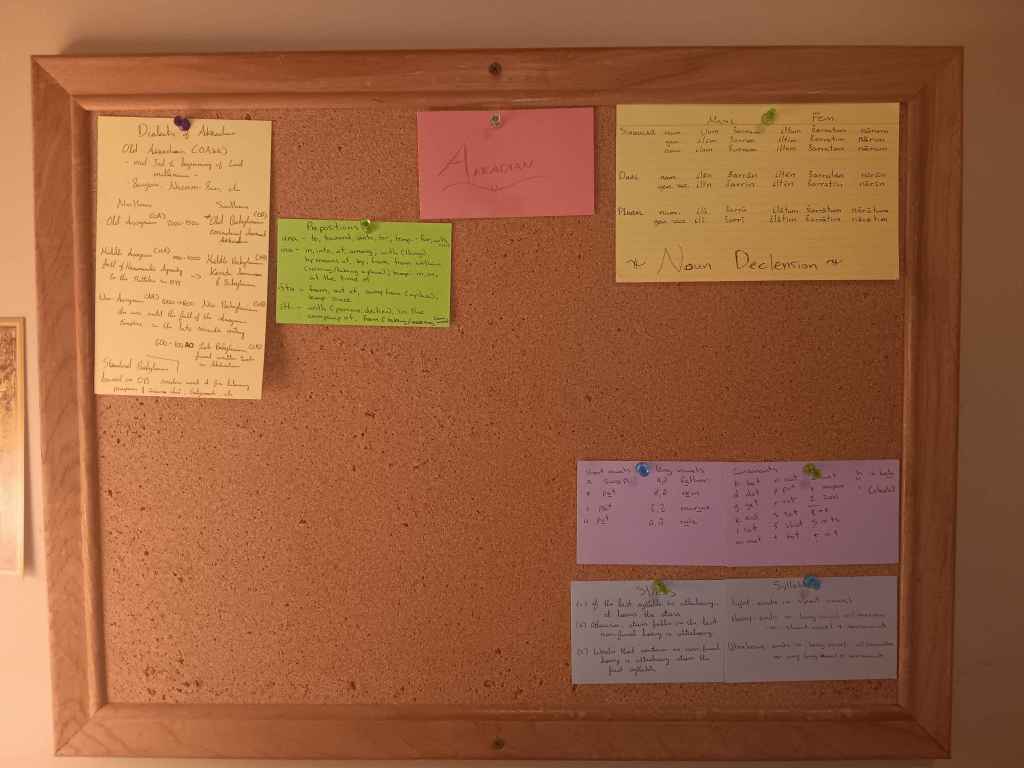
My Akkadian board has grown to include my preposition cheat sheet, as well as a noun declension chart. 🙂 It’s silly, but I find it kind of a satisfying progress marker.
Cuneiform
In skimming ahead, I’m not impressed with how little Huehnergard works with us on cuneiform in the future lessons, and I’m a little worried about the readability of the symbols. It’s hard enough as it is to tell a macron from a circumflex sometimes with the quality of the pdf scan I’m working from.
The diagram in Introduction to Ugaritic seems pretty straight forward and is very clear, so once I get my molding clay tomorrow, I’ll give it a shot.
I don’t really feel like much ground was covered this week, but I guess a little is better than none. Probably won’t be too unusual to spend more than one week on a lesson, so I’m not too worried.
 Ment of Wonder
Leave a comment